
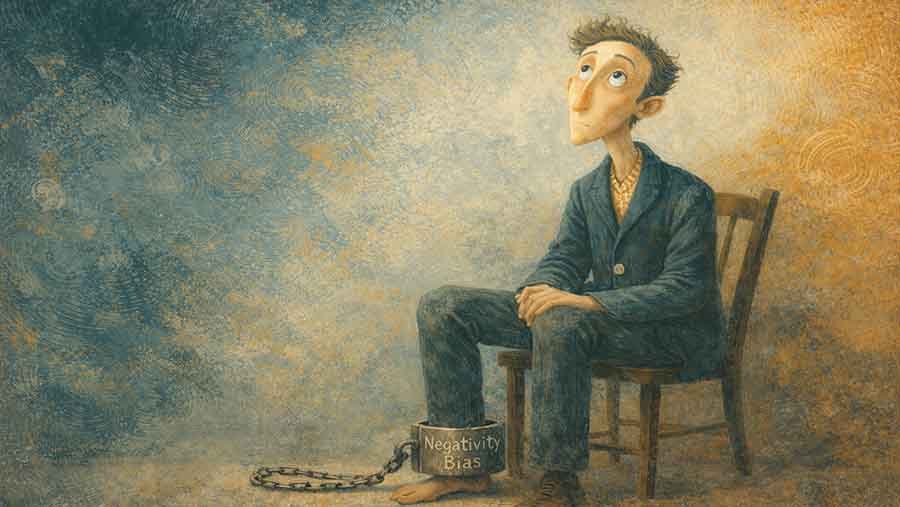
You can have a perfectly okay day. Then one small thing happens.
A delayed reply. A weird tone. A look that feels off. A friend who reads your message and disappears. A coworker whose reply or action sounds like they mean, “don’t bother me.”
And your mind forgets the whole day like it never mattered. It pulls that one moment closer. It zooms in. It asks, “What did that mean?” Then it asks the more dangerous question: “What does that mean about me?”
That’s how negativity bias works in social life.
It doesn’t scream. It whispers. It doesn’t come like a storm. It comes like a pin. And then your mind turns that pin into a sword. You don’t need “positive thinking” for this. You need a different way to respond when your brain starts scanning for danger in human behavior.
Because your brain still thinks it does security work. It watches for threats. It wants certainty. It hates the unclear. And social life stays unclear most of the time.
This is why negativity bias hurts your Social Experience so much. People don’t always hurt you directly. They confuse you. And confusion gives your mind room to write scary stories. Let’s fix that. Practically.
1. Understand this first: your brain is not neutral
Your mind is not designed to make you happy. It is designed to keep you safe.
From an evolutionary point of view, missing one threat could mean death, but missing ten pleasant moments meant nothing. So your nervous system learned a cruel rule:
“Remember the pain. Forget the peace.”
That’s why:
- One insult overrides ten compliments
- One rejection outweighs many acceptances
- One awkward interaction defines your self-image
When you don’t understand this, your mind quietly turns on itself and thinks, “Why am I like this?”
No. There is nothing wrong with you. Something is primitive about you.
You can reduce negativity bias. But it doesn’t start with control, it starts with respectful awareness of how your mind works.
2. Stop asking: “Why did they do that?”
Most people waste emotional energy analyzing others.
- Why was he rude?
- Why didn’t she reply properly?
- Why did they ignore me?
These questions feel intelligent, but they secretly deepen negativity bias because they rehearse the injury.
Instead, ask a harder and more honest question:
“Why did my mind cling to this one moment so tightly?”
This shift changes the center of gravity. From society to self-awareness. When you notice your own reaction without judgment, something happens: that negative experience loosens its grip.
Not because it wasn’t painful, but because it is no longer unconscious.
3. Practice emotional accounting (not positive thinking)
People say, “Focus on the positive.”
That advice often feels insulting when you’re hurt. A better approach is emotional accounting. Not denial, not optimism, but balance.
Just ask yourself quietly:
- What exactly went wrong today?
- How many moments were neutral or okay?
- How many moments were actually supportive?
Do this honestly. No sugarcoating. You’ll often discover something uncomfortable: The negative moment was louder, not larger.
Negativity bias thrives on vagueness. Clarity weakens it.
When you count experiences instead of feeling overwhelmed by them, your mind slowly learns proportionality.
4. Learn to sit with the feeling without becoming it
This is where most people fail.
They don’t just feel hurt. They become the hurt.
“I was ignored” becomes “I am invisible.”
“I was criticized” becomes “I am incompetent.”
The feeling merges with identity.
Next time a social moment stings, try this internal posture:
“This hurts. I won’t explain it away. I won’t dramatize it either. I will let it exist without turning it into a story about who I am.”
This is not suppression. This is containment.
When emotions are allowed but not interpreted immediately, they pass through instead of embedding themselves in memory.
Negativity bias feeds on premature conclusions.
5. Notice how repetition makes negativity feel like the truth
If you replay a social injury repeatedly, it begins to feel objectively true, even if it is subjective.
This is how thoughts like these gain power:
“People don’t respect me.”
“I’m always misunderstood.”
“Social situations drain me.”
Ask yourself this genuine question:
“Did this happen once… or have I turned it into a story?”
The mind confuses familiarity with accuracy.
Each time you replay a moment, you are not remembering it, you are reshaping it. And negativity bias ensures each replay becomes heavier than the last.
Interrupting repetition is one of the most practical tools you have.
- Change your physical posture
- Change your environment
- Speak your thoughts out loud once, and then stop
Rumination is not depth. It is emotional addiction.
6. Build one quiet practice of positive registration
Positive moments do not register automatically. They must be consciously absorbed. This doesn’t mean affirmations or gratitude lists that feel forced.
It means this simple act:
When something neutral or kind happens, pause for 5 seconds. That’s it.
Let your body feel it. The tone of the voice. The ease in your chest. The absence of threat. Your brain needs time to encode safety. Pain encodes instantly. Peace does not.
This small pause trains your nervous system to recognize that not every social interaction is dangerous. Even if one was uncomfortable.
7. Accept this truth: Some negativity will always remain
Most people secretly believe that healing means reaching a point where nothing hurts anymore. Where comments don’t sting. Where rejection doesn’t bother you. Where awkward moments slide off like water.
That expectation itself becomes a quiet source of suffering.
Because when negativity shows up again, and it always does, you don’t just feel hurt. You feel defeated. You think something went wrong. “I thought I was past this.” “Why am I still affected?” “What’s the point of all this self-work if I still feel like this?”
But the truth is simpler and more uncomfortable: a mind with zero negativity bias would be dangerous. It wouldn’t notice red flags. It wouldn’t remember past betrayals. It wouldn’t learn from social pain. It would keep walking into the same situations again and again, mistaking openness for wisdom.
Negativity bias isn’t the enemy. Unconscious negativity bias is.
The real work is not removing the pain but changing what the pain touches inside you. When negativity rules your self-image, one bad moment becomes a verdict. That’s when pain crosses a line, from experience to identity.
A healthy mind doesn’t deny the hurt. It also doesn’t rush to defend itself with fake confidence or forced positivity. It does something quieter, almost invisible.
A healthy mind says:
“Yes, that hurt. And no, it doesn’t define the whole of reality or me.”
This is what maturity actually looks like in daily social life.
So you don’t become endlessly positive. That would be brittle. You become grounded. And a grounded person can feel pain without losing their center.
A deeper truth that most people miss
Negativity bias thrives when your sense of self depends on how moments land. The more your identity rests on approval, smoothness, or being liked, the more power every small social signal holds over you.
Reducing negativity bias is not just about thinking better. It is about standing on something steadier inside yourself.
When your worth does not swing with every interaction, the mind stops scanning social life like a threat map.
You still notice pain. You still care.
But you no longer collapse into every pause, tone, or silence. And slowly, quietly, social life becomes lighter.
Not because people have changed. But because you have stopped fighting shadows inside your own mind.
How Negativity Bias Damages Your Social Experience? Read here…

By
Raj
Rajesh Sharma is a freelance IT Consultant who has found his new passion in digital writing. On this blog, he writes about Social Experience (SX) and shares tips on improving them. View more posts


Related Posts


2024 © socialexperiencehub.com. All rights reserved.