
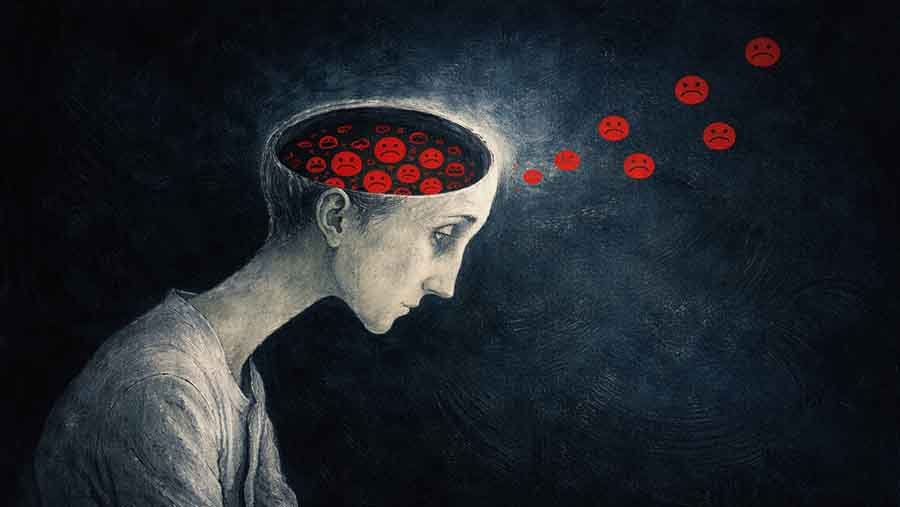
What do you remember more clearly, a praise or an insult? If you are like me, you will say insult. Actually most people will say insult.
This is negativity bias. It’s a brain’s natural tendency to notice, remember, and react to negative events more strongly than positive ones. It’s a survival leftover from when danger was everywhere. The brain evolved to scan for threats in the wild. Now it scans for modern threats like rude comments, cold tones, or irritated expressions. And it treats them like danger.
And this single bias shapes almost every Social Experience you have.
Why the brain loves bad news more than good news
Thousands of years ago, it was important to us to not miss a single danger, otherwise it could mean death. But, if we missed a compliment, it meant nothing.
So the brain learned to:
- spot negative signals faster
- store negative experiences deeper
- replay those moments longer
- attach emotions more tightly
- warn us whenever something feels similar
In simple words: A bad experience leaves a deeper footprint than a good one.
That’s why even one criticism overshadows ten praises. One rejection hurts more than a hundred casual approvals. One rude person ruins your day, but a kind stranger rarely makes your whole week.
Negativity weighs more than positivity. It’s not because we want it, because the brain prioritises it.
How negativity bias damages Social Experience
Negativity bias affects the way you interpret people, situations, conversations, and relationships. Let’s see how.
1. You start expecting the worst from people
If your brain acts like an overprotected security guard, you know it’s been affected by negativity bias. It would rather assume that there is danger and be wrong about it than assume that there is safety and get hurt. So even the smallest signal becomes a warning sign.
When negativity bias affects you, you can notice a pattern: You start taking even neutral behaviours as personal threats.
Someone sighs, you take it as a threat. Someone replies after 4 hours instead of 4 minutes, you think, “I must have said something wrong.” Someone uses a shorter tone, you translate it as, “They are irritated with me.”
You don’t see the situation. You see the danger that your brain creates.
2. You remember hurtful memories more vividly
Your mind is not a neutral storage system. It is a threat-detection machine.
So it remembers everything that is painful in nature such as insults, rejections, betrayals, embarrassing moments. Your brain stores them as warnings. It remembers the emotions of that time. Every detail it needs.
That’s why you can recall:
- the exact words someone used to humiliate you
- the expression on someone’s face when they dismissed you
- the sting of being ignored
- the ache of being excluded, even if it happened years ago
But warm and positive memories fade faster because the brain doesn’t treat them as survival signals.
Pain becomes a bruise that never fully heals, and pleasure becomes a breeze that passes quickly.
3. You become defensive even when no one is attacking
When you are under the influence of negativity bias, your mind behaves like a smoke alarm. It goes off even when someone is only making toast. Nothing dangerous is happening but the alarm screams anyway.
A firm tone. A delayed reply. A confused facial expression. None of these are real attacks.
But they feel like attacks because the brain connects them to old wounds. Those moments where you were judged, scolded, criticized, or msunderstood.
When such things happen, you face bad Social Experiences. Because misunderstandings grow fast. People feel confused by your sudden distance or reactions. You feel misunderstood because you believe you were reacting appropriately.
Slowly, small cracks form in relationships where no real problem exists.
4. You start avoiding new experiences
Negativity bias trains your mind to predict pain before anything even happens. Instead of asking, “What if this goes well?”, your brain jumps straight to, “What if this hurts me?”
That one thought is enough to stop you from taking even small social risks. You feel safer staying inside your familiar shell, even if that shell suffocates you a little.
When you imagine meeting new people, your mind doesn’t picture positive things. Things like the possibility of a laughter filled conversation or a real connection. It pictures judgement, awkwardness, or rejection. Your chest tightens. Your voice locks. Your instinct is to withdraw.
So you quietly skip the event, or cancel the plan, or pretend you’re busy. You get caught by your negative thoughts.
When you avoid situations and people, you feel like you are protecting yourself. In those moments, it gives you relief.
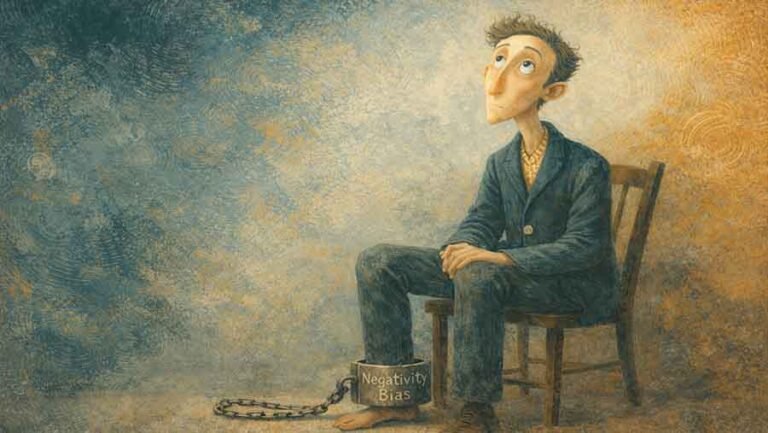
But over time, this comfort becomes a cage. You limit your friendships, your learnings, your confidence, your chances of meeting compatible people, and even your belief in yourself.
Negativity bias wants you to stay safe.
But when you stay safe, you pay the price. Your social world becomes smaller. You have fewer meaningful relationships. And you live a quieter version of your life than what you’re capable of living.
5. You stay in bad relationships longer than you should
Negativity bias doesn’t just exaggerate danger, it also exaggerates the fear of change.
So when a relationship becomes unhealthy, your mind doesn’t evaluate it with logic. It evaluates it with survival instincts.
Your brain begins to magnify three fears:
- Fear of losing someone: “What if I never find someone else?”
- Guilt of walking away: “What if I’m being selfish or impatient?”
- Anxiety of starting over: “What if the next person is even worse?”
These fears feel heavier than the pain you are actually experiencing. Your brain is biased to focus on potential threats, so even a tiny possibility of something going wrong in the future feels more real than the actual suffering happening right now.
And because of that, you cling to the relationship. You remember those old few good moments and you hold on to them, like they are proof that the relationship is worth saving.
This isn’t love. It’s the mind trying to protect you by keeping you in the familiar. Because familiar feels safe, even when it hurts.
That’s why so many people stay longer than they should. Not because they don’t see the problem, but because their psychology tells them that leaving is dangerous. Negativity bias traps you in a loop: fear of pain makes you tolerate pain.
And until you step out of survival mode, you can’t see clearly that real love doesn’t require endurance. It requires emotional safety. It longs for mutual respect. It demands consistency.
6. You judge people too quickly
Negativity bias makes you believe that one negative action defines a person.
If someone is rude once, your mind decides they are rude. If someone forgets something once, your mind labels them irresponsible. If someone withdraws for a day, you assume they don’t like you.
Your brain doesn’t pause and think what else might be happening in their life. It simply grabs the one painful moment and turns it into a full story.
This reaction comes from the ancient survival conditioning that says, “Better to be suspicious early than get hurt later.
The brain marks that person as a future threat and stores that memory with extra emotional charge. So the next time you see them, you don’t see the person, you see the memory of that unpleasant moment. Their complexity disappears. Their intentions, their struggles, their stress, or their humanity don’t even enter your mind. One bad moment becomes their identity.
Over time, this habit damages your Social Experience.
You lose opportunities to understand people and build deeper connections. You walk through life assuming the worst about others, while they walk through life unable to prove anything better to you.
A single instance of negativity gets more weight than all their positive qualities combined. And you stop noticing that how your low tolerance is shrinking your world.
Want to have good Social Experiences? Loosen your negativity bias
Understand this that negativity bias can’t be erased, but it can be softened.
It doesn’t mean becoming naïve. It means becoming balanced. You:
- stop giving small negative moments too much power
- pause before reacting
- ask yourself, “Is this fear or fact?”
- allow people to be human
- allow yourself to be human
- make space for positive experiences so they can shape you too
When negativity bias weakens, a shift happens immediately. You feel lighter around people. You stop assuming the worst. You stop replaying old wounds. You communicate more openly. Most conflicts dissolve before they begin.
Your Social Experience becomes richer, softer, and more authentic. Because a friendly world always begins with a friendly mind.
How to Practically Reduce Negativity Bias in Daily Social Life. Read here…

By
Raj
Rajesh Sharma is a freelance IT Consultant who has found his new passion in digital writing. On this blog, he writes about Social Experience (SX) and shares tips on improving them. View more posts


Related Posts


2024 © socialexperiencehub.com. All rights reserved.